
Cyber Security with AI: Skills, Tools, and Career Opportunities – HackerBook
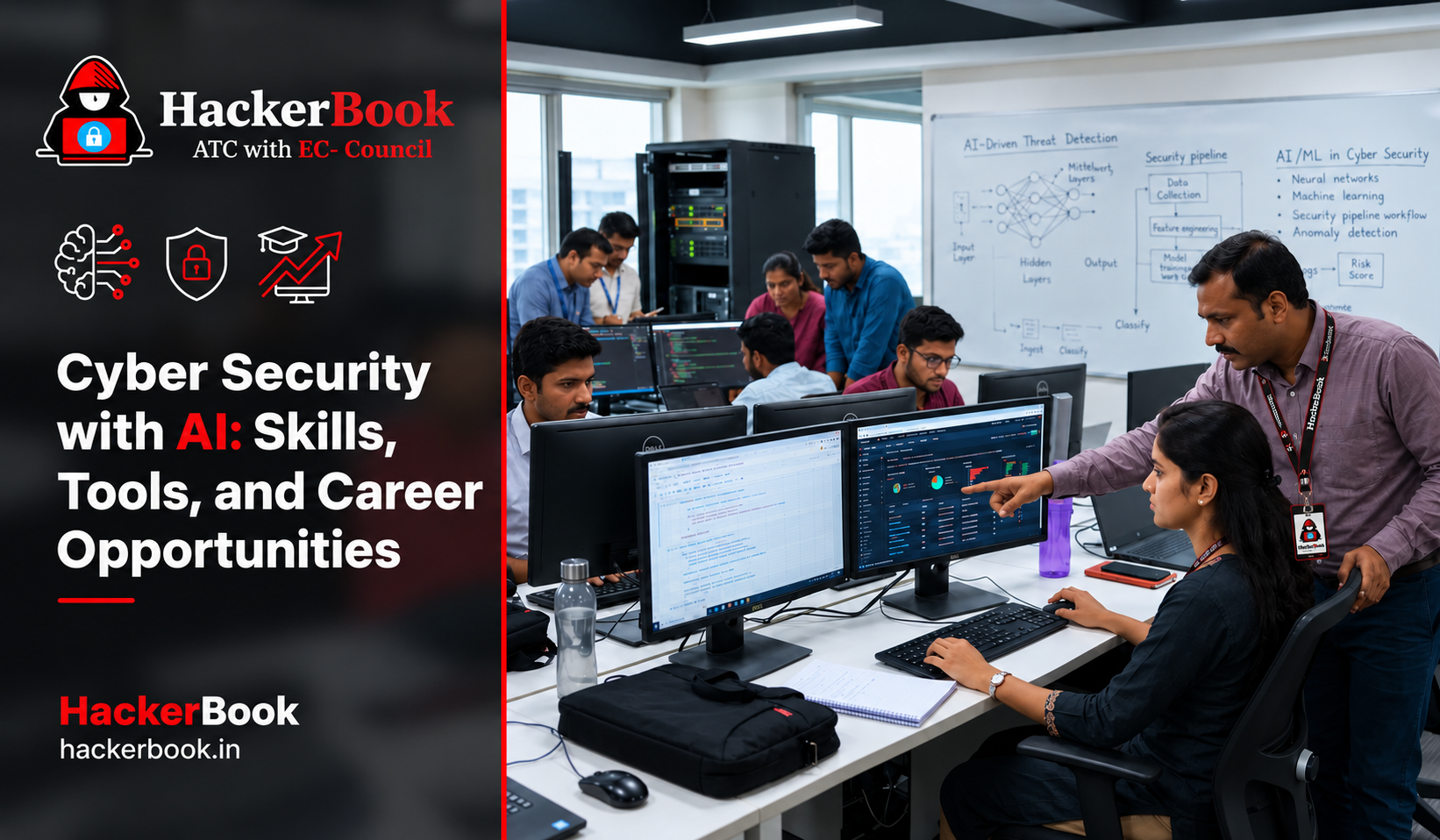
Cyber security with AI means using machine learning and other artificial intelligence techniques to detect threats, automate incident response, and analyse large volumes of security data for unusual activity. AI security tools can flag emerging attacks faster than rule based methods, but they still depend on skilled people to tune them, verify alerts and make final decisions.
As attackers adopt AI too, demand is growing for professionals who combine security fundamentals, ethical hacking skills and AI knowledge. In this guide, HackerBook Technologies explains how AI in cybersecurity works, the main AI security tools, the skills employers look for, the risks to watch, and how to choose cybersecurity and Ethical Hacking Course.
Key Takeaways
- Cyber security with AI uses machine learning to detect threats, automate response and analyse security data at scale, but human oversight remains essential.
- The main AI security tools are threat intelligence and network detection platforms, EDR/XDR, ML-driven SIEM and SOAR, UEBA and generative AI assistants.
- Ethical hacking with AI speeds up authorised testing; it never replaces permission or hands-on skills.
- Core career skills are security fundamentals, machine learning concepts, Python, ethical hacking and data privacy awareness.
- AI security tools carry their own risks, including data exposure, compliance gaps, third-party weaknesses and model attacks.
- When comparing cybersecurity training in Bangalore, prioritise hands-on labs, AI-specific modules and experienced trainers.
- HackerBook helps learners build practical cybersecurity skills through hands-on training.
What Is AI Used for in Cybersecurity?
AI in cybersecurity is used mainly for threat detection, automated incident response, continuous network monitoring and fraud prevention. It analyses security data in real time and uncovers unusual activity that traditional, signature based tools often miss, helping security teams keep pace with the volume and speed of modern attacks. AI helps analyse massive amounts of security data in real time, uncovering threats that traditional tools often miss. Today, AI powers several core cybersecurity functions:
- Intelligent threat detection: Spots known and unknown attacks by learning normal patterns in network activity.
- Automated incident response: Prioritises alerts and resolves routine incidents without human help, allowing teams to focus on serious breaches.
- Continuous monitoring: Identifies and flags network risks round the clock.
- Fraud prevention: It detects abnormal transactions and user behaviour.
How Is AI Transforming Cyber Security in India?
AI is changing cybersecurity in India by enabling faster threat detection, automating routine response tasks, and improving the accuracy of incident handling. According to the International Journal for Multidisciplinary Research (IJFMR) report on AI-powered cyber security (February 2025), AI gives Indian organisations new ways to anticipate and manage digital risks.
- AI-driven analytics help security teams spot suspicious activity that traditional monitoring would miss, especially in large and complex networks.
- Automated incident response lets systems react to threats at machine speed while reducing manual work.
- Predictive modelling helps organisations fix vulnerabilities before attackers exploit them, making defences more proactive.
AI is also making cyber defence more adaptive, which pushes Indian security practitioners to continuously update their practices and work alongside these systems.
What Are the Top AI Security Tools for Cybersecurity Professionals?
The most widely used AI security tools fall into five categories: threat intelligence and network detection platforms, endpoint detection and response (EDR), security information and event management (SIEM) with machine learning, user and entity behaviour analytics (UEBA), and generative AI security assistants. The right choice depends on your organisation’s risk profile and technological environment.
| Tool category | What it does | Example tools |
| Threat intelligence and network detection | Uses machine learning to spot anomalies and emerging threats in real time (Algora, August 2025) | Darktrace, Vectra AI |
| Endpoint detection and response (EDR/XDR) | Uses behavioural models to detect and contain malware and ransomware on devices | CrowdStrike Falcon, Microsoft Defender for Endpoint, SentinelOne |
| SIEM and SOAR with machine learning | Correlates logs, ranks alerts and automates response playbooks for rapid mitigation | Splunk Enterprise Security, Microsoft Sentinel |
| User and entity behaviour analytics (UEBA) | Flags abnormal activity across networks, including insider threats | Exabeam, Securonix |
| Generative AI security assistants | Summarise incidents, explain alerts, and draft queries and reports | Microsoft Security Copilot, Gemini in Google Security Operations |
According to Insights, integrating AI into cybersecurity brings advanced solutions but also creates new vulnerabilities, so professionals need to balance the benefits with careful oversight.
How Does AI Improve Threat Detection and Incident Response?
AI improves threat detection and incident response by classifying network anomalies more accurately than rule based tools, monitoring behaviour in real time, and combining several models to identify complex attacks. Algora (August 2025) reports that machine-learning-based intrusion detection can improve anomaly recognition and reduce false positives.
- Anomaly classification is more accurate with machine learning than with traditional, rule-based tools.
- Real-time behaviour monitoring with deep learning helps detect complex attack patterns, such as those targeting IoT devices and industrial control systems.
- Ensemble and hybrid models combine multiple AI techniques to improve the identification of distributed denial-of-service (DDoS) attacks and advanced malware.
How Is AI Used in Ethical Hacking?
Ethical hacking with AI means using AI tools to support authorised security testing. Penetration testers and red teams use AI to speed up reconnaissance, sort scan results, prioritise vulnerabilities, review code and draft reports. AI does not replace manual testing skills, and every test still requires written permission from the system owner.
Common uses of AI in ethical hacking include:
- Reconnaissance and asset discovery: Summarising large volumes of public information about an organisation’s attack surface during an approved engagement.
- Vulnerability prioritisation: Ranking scanner findings by likely exploitability and business impact so testers can focus on what matters first.
- Code review: Flagging insecure patterns in source code for a human tester to confirm.
- Phishing simulations: Designing realistic, approved awareness campaigns for employees.
- Reporting: Turning technical findings into clear remediation steps for developers and managers.
Ethical hackers also need to understand how attackers misuse AI, for example, to write convincing phishing messages, and how AI systems themselves can be attacked through prompt injection or training-data poisoning. The OWASP Top 10 for Large Language Model Applications and MITRE ATLAS are two widely used references for these AI-specific threats.
What Skills Do You Need for a Career in Cyber Security with AI?
A career in cybersecurity with AI needs strong security fundamentals, working knowledge of machine learning, Python programming, hands-on ethical hacking skills and awareness of data privacy rules. According to KnowledgeHut (March 2026), responsibilities will keep changing as automation and AI-powered tools become central to security operations, so continuous learning matters as much as any single skill.
Key skills to develop include:
- AI and machine learning concepts to assess and secure AI-driven systems.
- Network security and threat analysis to interpret AI-generated alerts and identify real anomalies.
- Python programming, the most common language for security automation and AI work.
- Ethical hacking and penetration testing are used to test systems, including AI-powered applications, in the same way an attacker would.
- Data privacy and governance, since AI can amplify privacy risks, as noted by IJFMR (February 2025).
- Adaptability and collaboration to work effectively with both human colleagues and AI tools.
The rapid pace of AI-driven change means today’s best practices may need updating tomorrow.
What Are the Main Privacy and Security Risks of AI Security Tools?
The five main risks of AI security tools are data privacy exposure, compliance failures, unvetted third-party tools, model vulnerabilities and low user awareness. According to insights, these risks exist even with widely used AI platforms, so organisations should review what data they share and how each tool is secured.
- Data privacy exposure: sensitive documents uploaded to an AI platform may be accessed or processed in ways you did not intend.
- Compliance failures: using AI tools without checking them against regulations can expose organisations to legal or policy violations.
- Unvetted third-party tools: many AI services are third-party applications, and weak security on their side can open the door to breaches.
- Model vulnerabilities: attackers can exploit flaws not only in software code but also in the logic of machine learning models.
- Low user awareness: employees who do not understand how AI works may leak confidential data or trust unverified outputs.
Safe use of AI in cybersecurity means regularly reviewing what information is shared and checking the security record of each tool.
What Career Opportunities Are There in AI and Cybersecurity?
Career paths that combine AI and cybersecurity include security analyst, incident responder, security engineer, security data scientist and penetration tester. Demand for these roles is high as companies work to protect sensitive information from advanced threats, and familiarity with AI tools is increasingly an advantage in all of them.
| Role | What they do | How they use AI |
| Security Analyst | Monitors systems for suspicious activity | Uses AI-powered tools to analyse logs and spot patterns manual review would miss |
| Incident Responder | Assesses and contains breaches | Uses AI to assess impact quickly and coordinate automated responses that prevent escalation |
| Security Engineer | Builds and maintains secure environments | Integrates AI-driven detection into existing security architecture |
| Security Data Scientist | Develops and improves detection models | Builds models that detect threats, process network traffic or automate incident response |
| Penetration Tester / Ethical Hacker | Tests systems with permission to find weaknesses | Uses AI for reconnaissance and prioritisation, and tests AI applications for new attack types |
According to Economic Times (April 2024), the need for experts in these areas will likely continue to grow as technology evolves and threats become more complex.
How Do You Choose Cybersecurity Training in Bangalore That Covers AI?
Choose cybersecurity training in Bangalore that teaches security fundamentals first, includes hands-on labs with real AI security tools, covers ethical hacking with AI, and is taught by practising security professionals. Before you enrol, compare the syllabus, lab access, trainer experience, certification alignment and placement support.
Use this checklist when comparing programmes:
- Foundations first: Networking, Linux, web application security and threat analysis come before advanced AI topics.
- Hands-on labs: Practical work with SIEM, EDR and penetration-testing tools, not only slides and theory.
- AI-specific modules: How AI in cybersecurity works, plus AI-specific threats such as prompt injection and data poisoning.
- Experienced trainers: Instructors with verifiable industry experience in security operations or penetration testing.
- Certification alignment: Preparation that maps to recognised certifications, such as CompTIA Security+, CEH or OSCP, if credential is your goal.
- Practical details: Batch size, weekday or weekend schedules, online or classroom options, total fees and what placement support actually includes.
What Should an Ethical Hacking Course in Bangalore Include?
A good ethical hacking course in Bangalore should cover the full testing process (reconnaissance, scanning, exploitation, privilege escalation and reporting) in legal lab environments and show how AI assists each stage. Look for capture-the-flag practice, real-world case studies, and clear guidance on legal authorisation and responsible disclosure.
HackerBook Technologies offers cybersecurity and ethical hacking courses in Bangalore designed to build practical skills in network security, penetration testing, vulnerability assessment, and ethical hacking fundamentals. Through structured training and hands-on learning, students can strengthen their technical knowledge and prepare for cybersecurity roles.
Frequently Asked Questions
No. AI cannot fully replace traditional cybersecurity methods. It augments existing practices by automating detection and response, but expert human oversight and layered defences remain essential for handling complex and evolving threats.
Yes. Open-source platforms such as Wazuh (security monitoring and detection) and network monitoring tools such as Zeek and Suricata are widely used, and their data can feed machine-learning analysis. Many commercial AI security tools also offer free tiers or trials. Features change often, so check each project’s current documentation.
Ethical hacking with AI is legal only when you have explicit written authorisation from the owner of the systems being tested and stay within the agreed scope. In India, unauthorised access to computer systems is an offence under the Information Technology Act, 2000, whether or not AI tools are used.
Basic programming helps a lot. Python is the most common language for security automation and machine learning, so beginners usually learn Python scripting alongside networking and Linux fundamentals. Advanced model development is needed mainly for roles as security data scientists.
Key challenges include adversarial attacks that manipulate AI models, privacy concerns when handling sensitive data, a shortage of skilled professionals, and attackers using AI to create new threats.
AI security tools automate monitoring, flagging and reporting, which makes it easier to track compliance with data protection rules such as India’s Digital Personal Data Protection Act, 2023. They do this by quickly identifying anomalous activity and potential breaches that need to be investigated or reported.
Conclusion: Your Next Step in Cyber Security with AI
Cyber security with AI is reshaping how organisations in India detect, prevent and respond to threats. The professionals who stand out combine strong security fundamentals with practical AI and ethical hacking skills, and they keep learning as tools and threats change.
To build those skills with hands-on guidance, explore the cybersecurity training and the ethical hacking course in Bangalore and Hyderabad from HackerBook Technologies, or contact our team to discuss which programme fits your goals.